
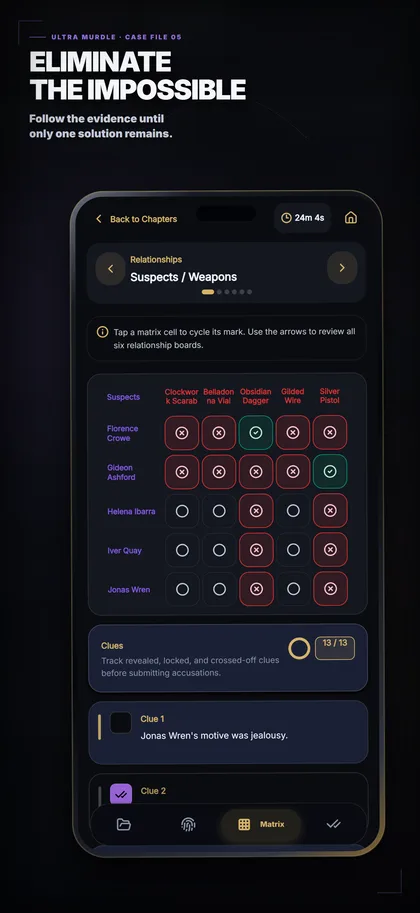
The basic idea: every item is used once
Imagine three suspects and three locations. Each suspect visited exactly one location, and each location belongs to exactly one suspect. The grid records whether a pairing is confirmed, eliminated, or still possible.
| Suspect | Conservatory | Archive | Clock Room |
|---|---|---|---|
| Nadia | ✓ | × | × |
| Omar | × | ? | ? |
| Salma | × | ? | ? |
Once Nadia is confirmed in the Conservatory, that location is eliminated for Omar and Salma, and the other locations are eliminated for Nadia. One fact changes five squares.
Four reasoning patterns that solve most grids
Direct match
A clue names two items that belong together. Confirm their intersection.
Direct exclusion
A clue says two items do not belong together. Eliminate their intersection.
Last possibility
If every option but one in a row or column is eliminated, the remaining option is confirmed.
Linked relationship
If Nadia matches the Conservatory and the Conservatory matches revenge, Nadia matches revenge.
Why negative information matters
A logic puzzle is rarely solved by positive statements alone. Three separate exclusions can be more useful than one direct match because they force a final remaining possibility.
Treat every “not,” “neither,” “different from,” and comparative clue as structural information. Mark the consequences immediately so you do not have to hold them in memory.
A reliable solving sequence
- Enter every direct confirmation and elimination.
- Complete the rows and columns affected by each confirmation.
- Find rows or columns with only one possibility left.
- Carry confirmed relationships between category pairs.
- Re-read relative clues after the easy structure is visible.
- Check uniqueness and every clue before submitting.
How Ultra Murdle expands the grid
Ultra Murdle cases use five suspects, five tools, five locations, and five motives. That creates several connected category pairs rather than one isolated table. A fact discovered in one pair can resolve uncertainty in another.
- Story evidence gives the puzzle an investigative context.
- Six difficulty levels introduce longer and more indirect chains.
- Optional hints help identify the next productive deduction.
- The final verdict checks the complete accusation, not one isolated guess.
Put the method to work
1,355 cases are waiting.
Start with an approachable file, then follow the archive into deeper chains of deduction.